How to Turn One Piece of Content Into 10+ Posts
"Post more consistently" usually turns into "come up with more ideas," which is the wrong problem to solve. Most people don't have an idea shortage. They have an idea they used once and then moved on from. One well-chosen piece of content, pulled apart properly, is worth more than ten separate ideas rushed out the door.
Here is how to actually get 10 or more posts out of a single piece of content, without any of them feeling like filler.
Start with the right kind of source
Not everything repurposes equally well. The best source material has some depth to it: an opinion, a process, a result, or a story with a beginning and an end. A single tip ("use bullet points in your emails") doesn't stretch far. A 20-minute conversation about why you changed how you price your services does.
Good sources for a 10+ post run:
- A podcast episode or a recorded client call (with permission)
- A long-form article or newsletter issue you already wrote
- A YouTube video or webinar recording
- A results write-up: a project, a launch, or an experiment with a before and after
Break it into three layers, not ten random posts
Rather than hunting for 10 disconnected ideas, split the source into three layers. Each layer naturally produces a few posts, and together they add up to more than 10 without any of them repeating the same angle.
Layer 1: the core argument
The single biggest claim or lesson in the piece. This becomes your main LinkedIn post, your video caption, and the headline of your newsletter. One idea, three formats.
Layer 2: the supporting points
Most long-form content makes 3 to 5 smaller points on the way to the main argument. Each one is a post on its own. A 20-minute podcast episode about switching to project pricing might also touch on how to have the pricing conversation, how to handle a client who pushes back, and how to know when you're underpricing. That is 3 more posts, each specific enough to stand alone.
Layer 3: the reactions and questions
This layer only exists after you publish layers 1 and 2. Whatever people ask in the comments, reply to, or push back on becomes its own follow-up post. This is the layer most people skip, and it is often the easiest content to write because someone else already told you what they want to know.
A real worked example
Here is what a single-source batch actually looks like, using a real video instead of a hypothetical one. A creator using Reshaper AI took one YouTube video about quitting Instagram Reels and ran it through the Content Engine once, generating a full bundle across formats in a single pass:
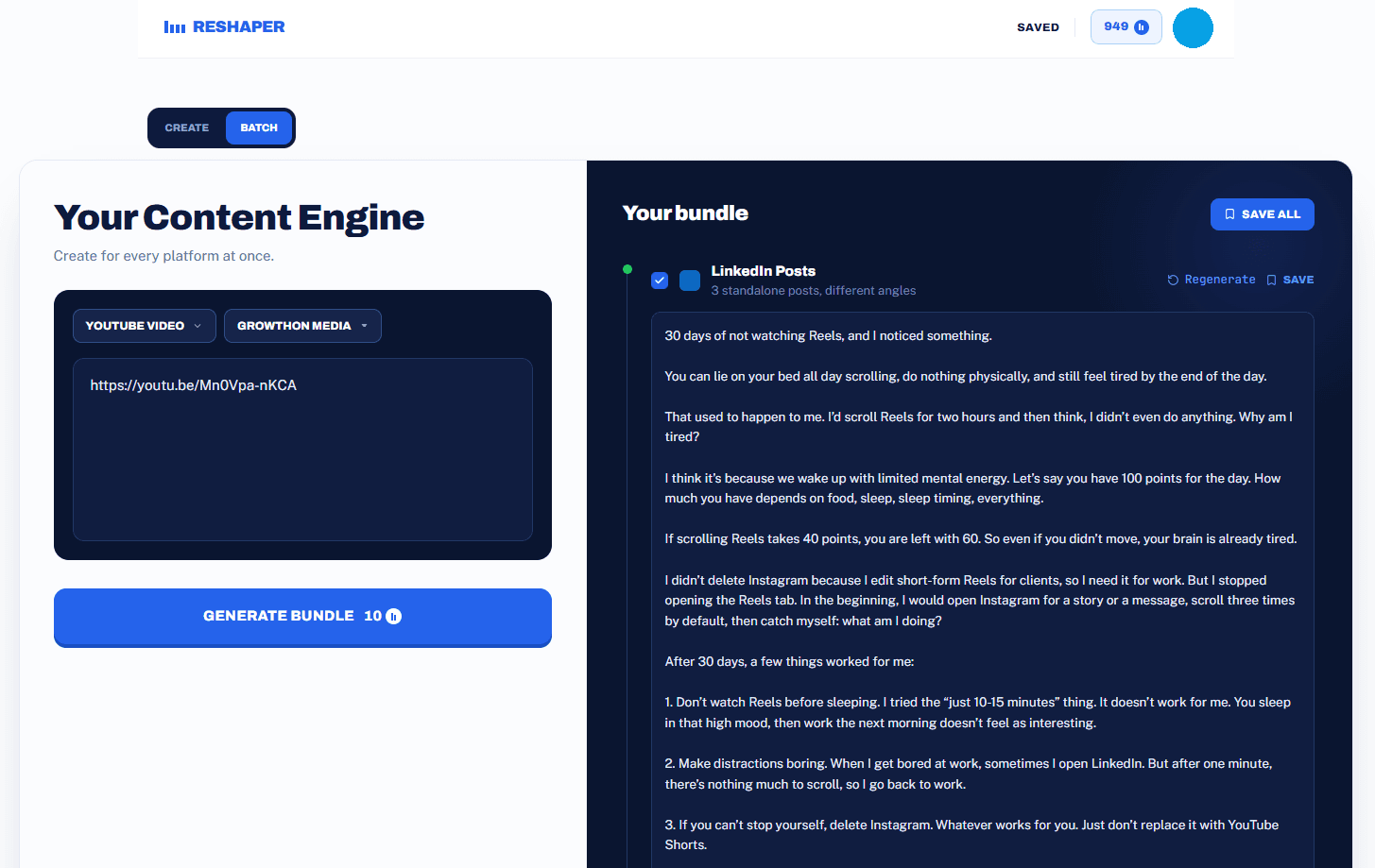
That one pass produced 3 standalone LinkedIn posts, each pulled from a different angle in the same video, none of them a shortened rehash of the others. The same bundle also generated a designed carousel and a set of short Substack notes from that same source:
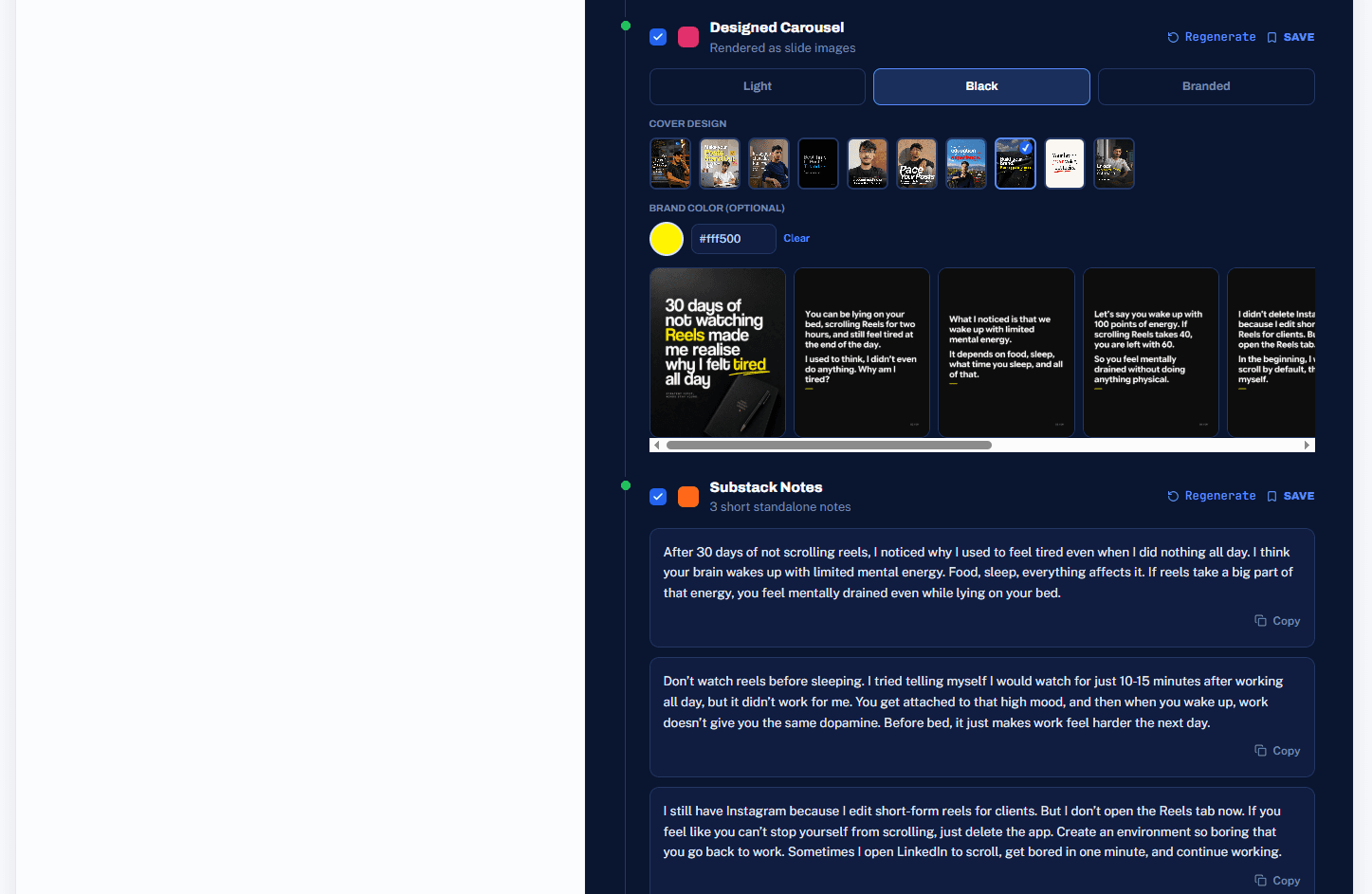
That is 3 LinkedIn posts, one carousel, and 3 notes, 7 pieces of content, from one video, in one generation. Layer 3, the follow-up posts answering whatever people ask in the comments, would still be written separately once the first batch is out.
Where this breaks down
- Splitting too thin.If a layer-2 point can't stand on its own without the context of the original piece, it's not ready to be a separate post yet. Combine it with a neighboring point instead.
- Publishing all 10 in one week. Ten posts from one source, spaced across three to four weeks, reads as a creator with a lot to say. The same ten posts in five days reads as someone emptying a content calendar template.
- Picking a shallow source. If the original piece only makes one point, forcing it into 10 posts means padding, and padding is what makes repurposed content feel like filler in the first place. Some ideas are a single good post, not ten.
Frequently asked questions
How long should I wait between posts from the same source?
A few days at minimum, usually spread across 2 to 4 weeks for a full 10+ post run. There is no fixed schedule, the point is that no one reading your feed daily should be able to tell it all came from one recording.
Do I need to mention that a post is part of a series?
No, and most of the time you shouldn't. Each post should work as a standalone piece of writing for someone who has never seen the others. If it only makes sense as "part 3 of my hiring mistakes series," it needs more context added on its own.
What if I run out of ideas before I hit 10 posts?
Stop at whatever number the source honestly supports. Some pieces genuinely give you 6 good posts, not 10. Forcing a weak seventh post out of a source that's already been fully mined is worse than publishing fewer, stronger ones.
Turn one piece of content into posts for every platform in seconds.