How to Manage Content for Multiple Clients Without Losing Track
Managing content for one client is a workflow. Managing it for five is a filing problem. Somewhere between client two and client four, most social media managers and agencies hit the same wall: the voices start blending together, someone posts the wrong client's update to the wrong account, and half your time goes to remembering who wants what instead of actually writing.
Here is how to keep that from happening as your client list grows.
Give every client their own space, not a shared folder
The most common failure point is running every client out of the same Google Doc, the same Notion page, or the same AI chat history. It works for one or two clients. Past that, you are constantly scrolling to find which section belongs to which brand, and it's only a matter of time before a detail from one client's voice leaks into another client's post.
Each client needs their own separated space that holds, at minimum:
- Their voice and tone, ideally with real examples of how they actually write
- Any brand guidelines, banned words, or topics to avoid
- Their own content history, so nothing from client A ever shows up next to client B
In practice, that just needs to be a simple switcher, not a complicated system. In Reshaper AI, it looks like a plain list you pick from before you start writing:
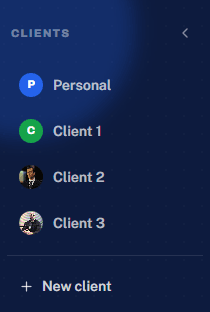
Picking a client from that list, instead of a shared doc or a scroll through old chat history, is the whole difference between remembering who wants what and just clicking the right name.
Write down the voice, don't rely on memory
"I know how they sound" works until you're juggling six clients and it's been three weeks since you last wrote for one of them. Keep a short, specific voice reference for each client: a few sentences on tone (direct vs warm, formal vs casual), 3 to 5 real examples of posts they've approved before, and anything they've explicitly said they don't want to sound like. This turns "does this sound like them" from a guess into a quick check against something written down.
Separate the source material from the output
Client content usually comes from calls, briefs, or their own raw notes. Keep that separate from the finished posts, and label everything by client before it goes anywhere near a draft. The mix-ups that actually happen, like posting one client's announcement on another client's account, almost always trace back to source material that wasn't clearly labeled in the first place.
Build one repurposing workflow, run it per client
Instead of inventing a new process for each client, use one repeatable workflow (get the source, pull out the moments, write for each platform, review before posting) and run it separately for every client's own material and voice. The steps stay the same. The content, the tone, and the opinions change completely because they're coming from a different source each time. This is the same idea covered in what content repurposing actually means, just run in parallel across several clients instead of one account.
Signs your current system is breaking
- You've second-guessed which client a draft belongs to before posting it
- Two clients' posts read like they were written by the same person, when they shouldn't
- You keep re-explaining a client's tone to yourself because it's not written down anywhere
- Onboarding a new client means rebuilding your whole process from memory
Any one of these is a sign the system is running on memory instead of structure, and that tends to get worse, not better, as you take on more clients.
Frequently asked questions
How many clients can one person realistically manage this way?
There's no fixed number, it depends more on how well each client's voice and guidelines are written down than on raw client count. Someone managing 8 clients with clear, separated voice references usually has an easier time than someone managing 3 clients out of memory and a shared doc.
What if two clients are in a similar industry and end up sounding alike?
That's usually a sign the voice reference for each one is too generic, built from industry norms instead of how that specific person actually talks. Pull examples straight from things they've personally said, in calls, emails, or approved drafts, rather than writing a voice description from scratch based on their niche.
Should each client see a different repurposing workflow, or the same one?
The same one. Changing your actual process per client makes it harder to onboard new clients and harder to spot when something in the workflow itself needs fixing. Keep one workflow, and let the client's own voice and source material be what makes each output different.
How this works in Reshaper AI
This is exactly what client spaces solve: a separate space per client, each with its own saved voice and guidelines, so switching between clients means picking a name from a list instead of rebuilding context every time. The repurposing workflow stays identical across every client, only the voice and the source material change.
Turn one piece of content into posts for every platform in seconds.